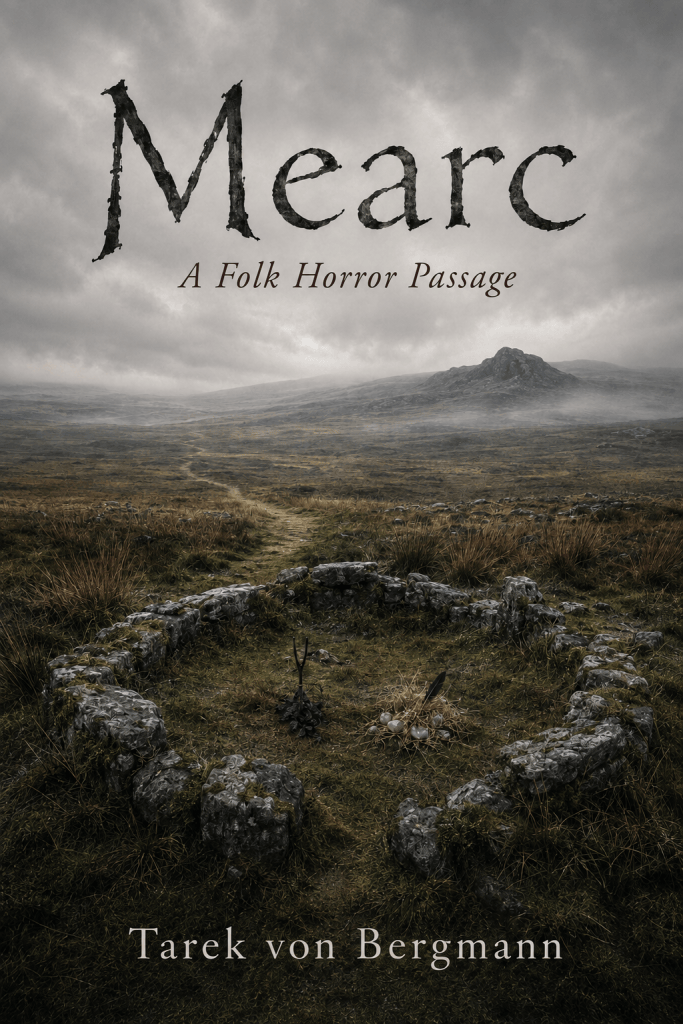
Eight cottages. Two farms. An old chapel. Not a single person.
On a burned summer afternoon, a passage begins through an empty village on the edge of Dartmoor.
Nothing has been destroyed. Washing still hangs outside the cottages. Boots wait beside doors. Cups remain on tables. At the old well, dried flowers, salt and a length of wine-red flax lie beneath an ash tree.
Beyond the village, an ancient track climbs towards the moor.
Along it are small figures hanging among thorns. Flowers laid across a stream. Red hands pressed against trees. A horse skull surrounded by old wax. Clothes abandoned across a meadow in numbers greater than the village could ever have contained.
And barefoot impressions leading uphill.
The path follows them.
Through woodland, gorge and open moor, human traces become older, stranger and increasingly difficult to separate from the landscape itself. Granite resembles bodies. Hawthorn raises its arms into mist. Water makes marks. Wind creates voices. Ancient dwellings emerge from the ground only to disappear again when viewed from another angle.
Nothing explains what happened.
Nothing needs to.
As afternoon becomes evening and evening becomes night, following gradually gives way to something more intimate: shelter, warmth, repetition, recognition — and the quiet human impulse to make meaning from what the world places before us.
MEARC: A FOLK HORROR PASSAGE is an atmospheric and meditative journey through landscape, memory, ritual and perception. A folk horror stripped of monsters and easy revelations, where the natural world remains entirely itself — and becomes no less uncanny for it.
The moor offers no answer.
Only traces.
And eventually, traces of us.
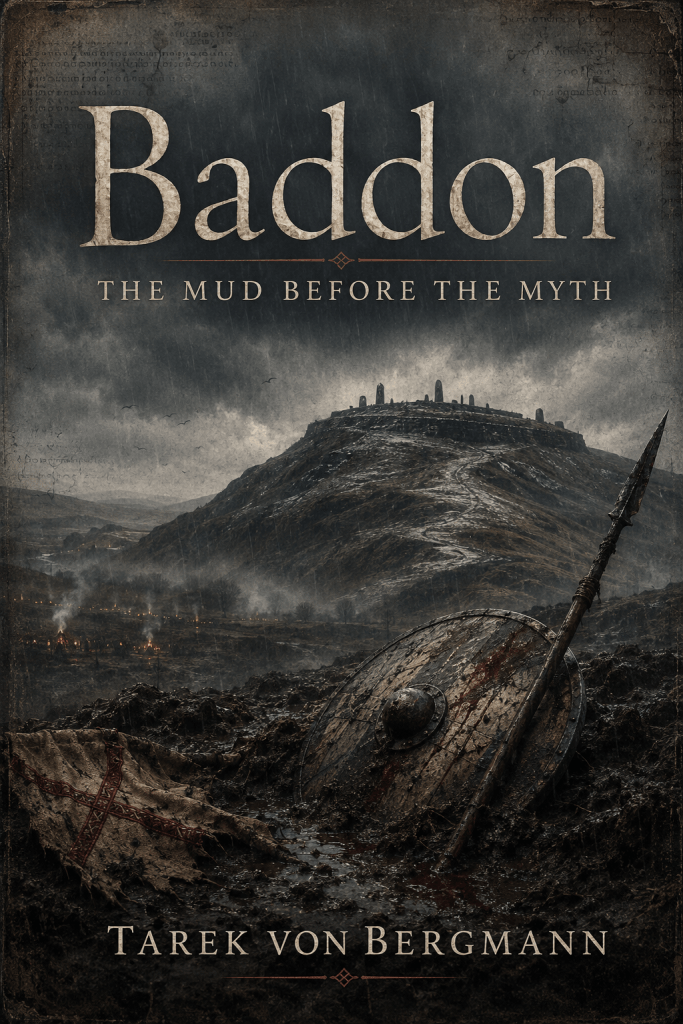
Baddon
A hill. A siege. A victory remembered wrongly.
More than half a century after Baddon, an old soldier sits in a rain-dark hall and listens as a young bard sings of the great victory that saved Britain. In the song, the hill is white, the dead are noble, the saints are clean, and peace is given by famous men.
Cunorix knows better.
He was there.
He remembers the winter campaign before the hill. The mud, hunger, fever, quarrels, broken oaths, foul water, and men shitting blood in the cold. He remembers the mixed warband that held the western hollow: Britons, Christians, pagans, old Saxon settlers, boys sent by distant kings, priests with weapons, and men who had no clean name for what they were becoming.
Above all, he remembers the old lord who stood among them.
Not a king. Not a saint. Not the polished hero later generations would need. A hard, fair, weathered man with too many names and no name large enough to keep him. A commander who did not promise glory, only the bitter work of holding long enough for others to breathe.
As the bard’s beautiful lies fill the hall, Cunorix is forced back into the siege itself — into the western hollow, the cross in the rain, the false songs of command, the names of the dead, and the terrible question of what survives when living memory becomes history.
Baddon is a literary historical novel about the mud before the myth: a story of post-Roman Britain, fractured kingdoms, faith and older gods, Saxon newcomers and settled neighbours, and the human cost hidden beneath the first faint roots of legend.
Some victories do not bring peace.
Some truths are not sung.
In Rosalyn Lane: Arcanum, a city teetering on the brink of chaos becomes a stage where the haunting interplay of ancient occult forces and dystopian reality unfolds. Here, the boundaries of sanity blur, and the echoes of prophecies and cosmic enigmas linger in the shadows. This story does not merely invite you to follow its characters but pulls you into a relentless descent through the labyrinthine streets of a metropolis that mirrors our darkest fears and desires.
Infused with the ancient symbolism of Tarot and the philosophical weight of timeless mysteries, this tale is more than an exploration of fate. It’s a meditation on power and the inevitable consequences of wielding it. Within this world, prophecy intertwines with identity, revealing twisted reflections of our own pursuits and existential struggles. Through the lives of two men—one bound to a prophecy of violent redemption and the other to a symphony that will usher in an apocalyptic new dawn—we glimpse the frail and often perilous nature of human understanding.
Step into this shadowed path, where each page offers not only a chilling narrative but a mirror to your own journey. As you embark, consider what you might uncover—not merely in the unfolding of this dark world but within the recesses of your own. This is a tale for those who dare to venture where the line between destiny and choice is blurred, where the horror of the unknown beckons, and where the old gods still whisper their terrible truths.
Book One: The Fool
In a city where the rain falls like whispered secrets, and neon lights flicker over streets brimming with decay, two men stand on the precipice of destiny. John Baptist, a man haunted by the cryptic warnings of the Grey Father, is compelled by a prophecy that promises both destruction and redemption. He carries the weight of a perilous quest—to end the reign of four fallen kings and uncover a hidden child, a sacrifice deemed necessary to end a cycle of despair that has bound the city in chains.
Opposite him stands Sebastian Hawthorn, an elderly maestro driven by a passion that borders on madness. At 92, he faces his final performance, a symphony that will serve as both his legacy and his reckoning. His magnum opus is not merely a composition; it’s a ritual, an invocation of forces that lie beyond the grasp of human understanding. For Sebastian, this last performance is not just a piece of music but the final stroke that will shatter an era and beckon a new, apocalyptic dawn.
As their paths converge, John and Sebastian find themselves unwitting players in a game governed by ancient powers and insidious prophecies. Their lives, seemingly separate, are inextricably linked by the pull of an inevitable fate—a fate that neither can escape, and one that will plunge them both into the depths of a world on the brink of collapse.
This is the beginning of their story—a tale where shadows carry voices, and the symbols of Tarot breathe life into a city haunted by its own ghosts. As you read, prepare yourself to journey through a world where prophecy guides every step, and where the line between what is real and what is imagined dissolves under the weight of a grim and ever-present reality.
There are places the map avoids. Places the tongue avoids. Places where even prayer sounds thin.
I write this now with hands that no longer tremble from scrubbing floors, though they remember the feel of it—the sting of lye, the heat of wash-water, the little cracks in winter skin that never truly healed. Perhaps that is what time gives us: not forgetting, but a change in where the ache settles.
In the parish, the moor began at the last gate and never truly ended. It lay out there like a thought the village refused to think straight. It breathed mist through the gullies, threaded silence between cottages, and took names the way water takes footsteps: not violently, but completely.
And then, in 1890, two girls were found.
That sentence has been said so often it sounds simple. It is not. People have a hunger for neat beginnings, for clear causes, for a moment they can point to and claim, there—there is where it started. But nothing started that year. Something only rose to the surface.
The girls came out of the fog without their proper names and without the sort of story a parish can hold in its mouth without choking. Their speech arrived in fragments—half memory, half fever-dream, half something that sounded like the land speaking through a broken door. Those who believed in omens called them a warning. Those who believed in sin called them a test. The rest did what frightened people do: they watched, they whispered, they waited for permission to be cruel.
I was Lucy Tregenza then. A servant. A woman the village would later reduce to a line on stone, as if a line might hold a life. But before any of that, before the last night and the last gate and the last argument about what God wanted, there was simply a house that took the girls in and began to change.
Mr Harrowell tried to steady the world with ink and ledgers, collecting facts like kindling. The Prowse estate pressed its old will into every corridor, every locked room, every inherited silence. And Reverend Bartram stood before us in the chapel and gave our fear a holy shape.
Beyond the hedgerows lay Nine Welspryng: water over stone, caves that moaned in the wind, and a strange court of rock seats turned to the compass. The parish tried not to name it. Naming makes things real. Yet it returned to people’s mouths all the same—like a word spoken in sleep, like a prayer said wrong.
Rumour thickened. Livestock sickened. Men gathered, and torches made the fog look like a moving wall. When a community cannot bear its own dread, it chooses a story. Then it chooses a scapegoat. Then it calls the sacrifice mercy.
I have lived long enough—if living is the word—to know that folk horror has never belonged to monsters.
It belongs to people.
Of Mist and Omen is a lyrical, devastating historical inspired folk-horror novel told as a remembrance—about communal guilt and quiet devotion, about the difference between truth and the story a parish decides it can survive, and about what remains when the moor keeps the rest.
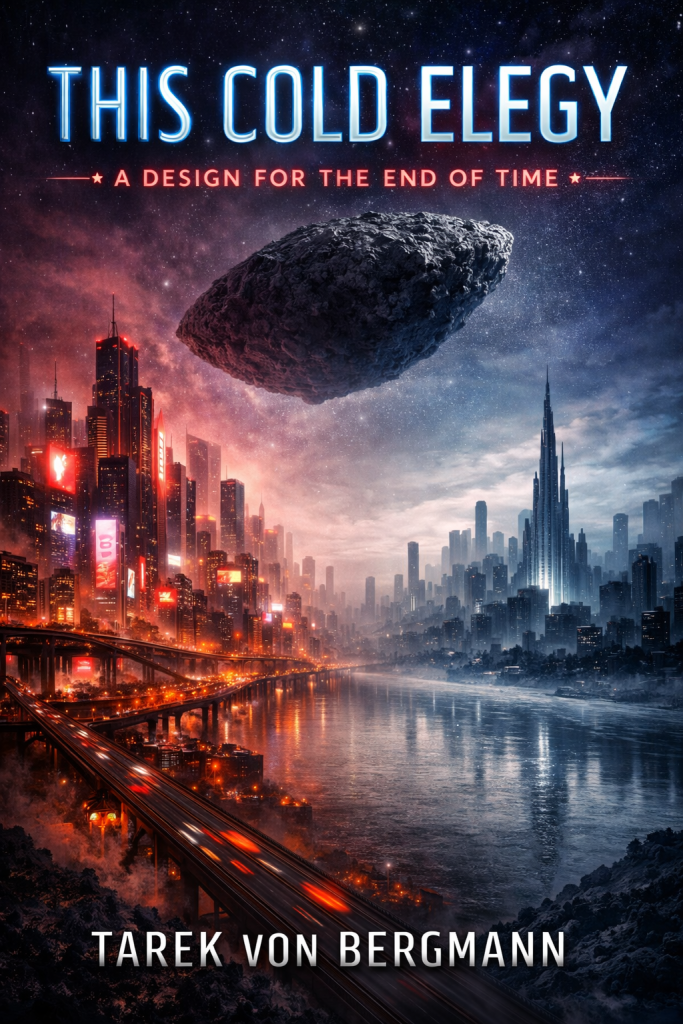
In Caldera, the neon never sleeps · and time has started to misbehave.
This Cold Elegy
Ellis Veidt used to front a forgotten post-punk band. Now he sells his instincts as a washed-out private investigator, trying to stay sober in a city that eats the vulnerable and calls it progress. Then an unmarked envelope arrives: crime-scene photographs of a woman he has never met… stamped June 2040 · eight years into a future that should not exist yet.
This Cold Elegy
Her name: Dr. Adrienne Calloway · an astrophysicist with a ruined reputation and an obsession the world refuses to take seriously. Her research points to Orochi-7, an object in the dark that doesn’t behave like anything we understand · and as institutions circle to take credit for her work, her life begins to fold inward, as if the universe has started editing her out of its own story.
This Cold Elegy
But the fracture doesn’t stop in 2032.
In 2086, the post-collapse metropolis of Nyx stands sleek, vast, and eerily under-inhabited · a city built from salvage, polished into denial. Its chief architect, Dominic Karras, discovers something impossible carved into his own blueprints: a recurring pattern, a hidden signature, a name that shouldn’t exist anywhere at all · This Cold Elegy. And as reality subtly rewrites itself around him, Dominic begins to wear a life that doesn’t belong to him: Mr. LeClair, a man of curated myth and immaculate suits, moving through a script already written.
Between these threads moves Shelley · Adrienne’s daughter, long since swallowed by the system and the city’s underbelly. She grew up on the edge of places people pretend not to see, and she knows what it means to survive the cracks. When the “strings” pull tight and the world turns funeral-quiet, Shelley becomes more than a witness · she becomes a hinge, carrying what Ellis leaves behind, chasing a destination that feels less like a place and more like a final cue: the Spire of Verdant Light.
As the timelines begin to rhyme · murder before motive, music inside architecture, lovers and ghosts folded into the same sentence · each of them is forced toward the same question:
What if tomorrow already happened… and someone designed it that way?
This Cold Elegy
This Cold Elegy: A Design for the End of Time is a neo-noir, time-fractured mystery with philosophical dread · where cities remember what people can’t, grief becomes a compass, and the future reaches backward with ink still wet.
Content note: themes of depression, grief, addiction, and suicidal ideation appear in the story

